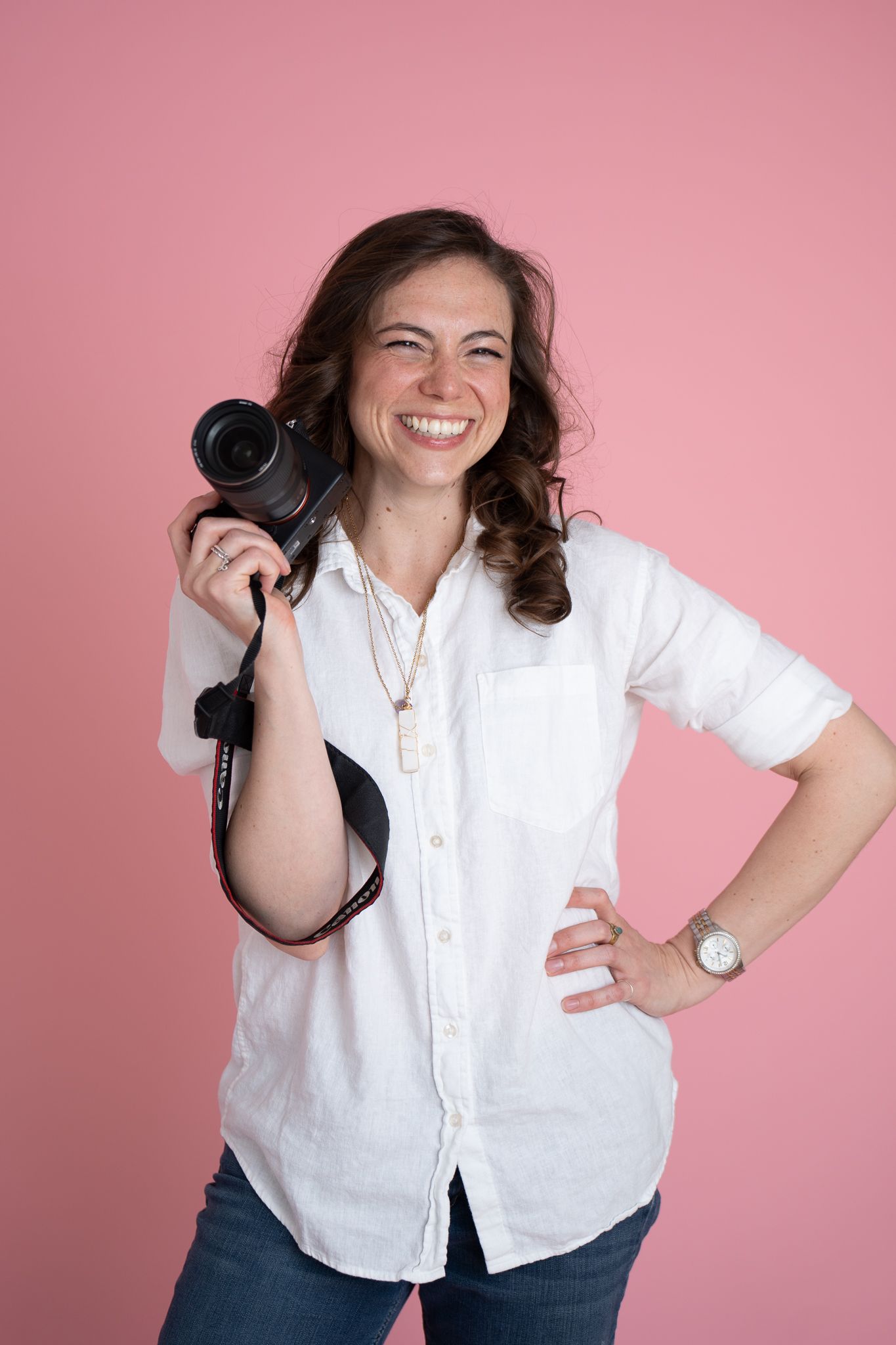
How to Feel Comfortable in Front of the Camera (Even If You're Awkward)
The short version (TLDR)
Camera anxiety is normal, almost universal, and it doesn't have to define your photos. What actually makes the difference is working with a photographer who leads with connection rather than instruction, uses movement to break through stiffness, and creates a genuine environment rather than a performance one.
You don't have to be comfortable in front of cameras in general. You just have to be comfortable in this session, with this photographer.
That's entirely achievable. I promise.
***
"I'm so awkward in front of cameras."
I hear this -almost word for word- from probably 80% of my clients before a session. People who are confident professionals, warmly funny in conversation, completely at ease with themselves in real life. And then a camera comes out and suddenly they feel like a cardboard cutout of a person.
Here's the truth: camera anxiety is almost universal. It has nothing to do with how photogenic you are. It has everything to do with self-consciousness- the sudden awareness of being observed, of performing, of wondering what your hands are supposed to be doing.
The good news is that it's also almost entirely solvable. Here's how I think about it.
First, let's normalize the anxiety
I want to be clear that there is nothing wrong with you if a camera makes you freeze up. You are not uniquely unphotogenic. You are not "bad at this."
What's actually happening is that most of us have very limited experience with being photographed in a way that feels safe and guided. We're used to snapshot culture- someone shoves a phone in your face at a birthday party, you have half a second to react, and the result is a photo you immediately untag yourself from. That's not a fair or accurate reflection of what you look like. It's a photo taken in an environment with no intention behind it.
A real portrait session is nothing like that. The difference is intention- on both sides.
Why guided connection beats stiff posing
Here's something I've learned: posing instructions rarely produce great photos. "Chin down, lean slightly left, shoulders back" ...technically correct, emotionally absent. People look posed because they are posed, and the camera sees exactly that.
What actually produces beautiful, natural images is a moment of genuine connection or engagement. And my job as a photographer is to create the conditions for those moments to happen.
In practice, this looks like spending the first few minutes of a session just talking- about your work, your family, what made you nervous about today, what you had for breakfast. Not because I need to know these things, but because the act of actually talking to someone naturally relaxes your face, shifts your posture, and makes your eyes come alive. The camera catches that transition.
I'm not going to stand three feet away in silence and yell "smile!" at you. That's a recipe for exactly the kind of photo you're dreading.
Movement changes everything
One of the most reliable ways to break through camera stiffness is to give people something to do rather than something to be.
Instead of "stand here and look natural" (an instruction that is essentially impossible to follow), I'll ask you to:
- Walk toward me slowly like you're heading to a meeting you're actually excited about
- Laugh at something- really laugh, even if I have to be silly enough to make it happen
- Look away and then back, like you just remembered something you like
- Adjust your jacket, move your hair, do the thing you actually do when you're gathering yourself
These aren't tricks. They're just moments of movement that interrupt the self-consciousness loop. When you're doing something, you stop monitoring yourself- and that's exactly when great photos happen.
When I worked with individual headshot clients like Jennifer (one of my portrait sessions), the brief we set for the shoot was "approachable, polished, and professional images for her website." We chose an outdoor location at Waterloo park -gorgeous landscaping, neutral limestone walls, a bit of urban texture- and used natural light during golden hour when it's soft and glowy. We talked through nerves before we ever started shooting. By the time the camera came out, it felt like a creative project we were doing together, not an evaluation.
That shift in framing matters enormously.
Connection > perfection, every single time
Here is what I want you to take away from this: the goal of a photo session is not a technically perfect image. It's an honest one.
The photos that people actually love -the ones they put on their walls, use as their profile picture for years, send to their mom- those photos have something alive in them. A real expression. A moment of actual feeling. Sometimes a little imperfection.
I can fix a lot of things in editing. I can't edit in warmth that wasn't there.
So when we work together, my entire focus is on making the experience feel good. Not just so you'll have a nice time (though that matters too), but because how you feel directly determines what the photos look like. A relaxed person with slight laugh lines in their eyes will always photograph better than a tense person with technically "perfect" posture.
Your job isn't to be a model. Your job is just to show up and let me take care of the rest.
A few practical things that also help
Beyond all of the above, there are some genuinely useful logistics that reduce anxiety before you even arrive:
Wear something you already feel good in. Not something you bought specifically for the session and feel unsure about. The outfit you reach for when you want to feel confident -that one. (If you want a second opinion, I'm always happy to review outfit options before your session.)
Know where you're going and arrive a few minutes early. Rushing to a shoot already raises your baseline stress level. Give yourself transition time.
Hydrate and moisturize the day before. This sounds small but it genuinely affects how your skin looks, especially in natural light.
Tell me what you're nervous about. Seriously. If you're self-conscious about something specific -a gap in your teeth, how you look when you laugh, your left profile- just tell me. I can work with that information and work with you- I got you. And honestly, the things people are most self-conscious about are almost never seen in the way they fear.
Lauren Leo is the founder of Lola Rosa Photography, based in Austin, Texas. Her approach to portraits is grounded in making people feel genuinely at ease -because that's what produces images people actually love. Learn more or book a session at lolarosaphotography.com.